
Tasers and stun guns, though both non-lethal, differ in their approaches to incapacitation. Tasers use high voltage and low amperage electrical pulses delivered via probes to disrupt muscle control, while stun guns employ direct contact conductive plates that interfere with nerve impulses through high voltage, causing severe muscle contractions and disorientation. Stun guns generally operate at lower voltage levels (50,000-150,000 volts) compared to tasers (up to 500,000 volts), making them better for specific contact situations and ensuring user safety. Both are effective in temporarily incapacitating assailants, providing crucial time in law enforcement or self-defense scenarios.
“Unraveling the Tactics: Taser vs. Stun Gun Differences Delved
In the realm of personal defense, understanding the nuances between Tasers and stun guns is paramount. This article navigates the intricate details, offering a comprehensive comparison. We explore the definitions and distinct mechanisms of these non-lethal weapons, with a close look at stun gun voltage and its impact.
Key topics include muscle interference comparisons, effectiveness in diverse scenarios, and legal considerations. By dissecting these differences, we empower individuals to make informed choices, ensuring safety and preparedness.”
Definition of Tasers and Stun Guns

Tasers and stun guns are both non-lethal weapons designed to incapacitate individuals, but they operate through distinct mechanisms. A taser, short for “theta gun” or “conductive energy device,” uses electrical pulses to disrupt muscle control in its target. It fires two probe-like electrodes that deliver a high-voltage electric shock, temporarily paralyzing the subject and making them easier to subdue.
A stun gun, on the other hand, generates a strong electric current that disrupts nerve impulses in the body. Unlike tasers that fire probes, stun guns maintain continuous contact with the target through conductive plates. This direct contact results in a powerful jolt of electricity that can cause severe muscle contractions and disorientation, temporarily disabling the individual without causing permanent harm. The key difference lies in their voltage levels; stun guns typically deliver lower voltages than tasers, which can fire up to 15 times the voltage of a standard stun gun.
– What are tasers?

Tasers, officially known as Electronic Control Devices (ECDs), are non-lethal weapons designed to temporarily incapacitate a person through electrical muscle interference. They fire two small probes connected to high-voltage, low-amperage electricity, disrupting muscle control in the target area. This causes an individual to experience a powerful contraction of their muscles, leading to temporary immobilization and disorientation.
Unlike stun guns, which also utilize electrical current to stun a target, tasers are typically fired from a distance, with probes that attach to the subject’s body. Stun guns, on the other hand, emit a continuous electric discharge and are often used by pressing them against an attacker’s body. The voltage output of a taser is generally higher than that of a stun gun, making tasers more effective at penetrating clothing and reaching muscle mass, but stun guns may be preferred for close-quarters combat or when aiming for specific points on the body.
– What are stun guns?

Stun guns, also known as electronic control devices (ECDs), are non-lethal weapons designed to temporarily incapacitate a person through electric muscle interference. They emit a high-voltage, low-current electrical pulse that disrupts the muscle’s ability to contract, causing a powerful jolt and temporary paralysis. This technology has gained popularity among law enforcement agencies and personal protection enthusiasts as an alternative to traditional firearms for self-defense scenarios.
These devices typically fire a small dart or project a beam of electricity towards the target, delivering a strong shock that can subdue an assailant without causing permanent damage. The stun gun’s effectiveness lies in its ability to deliver a controlled electrical discharge, with voltages ranging from 50,000 to 150,000 volts, ensuring the safety of both users and bystanders. Unlike tasers that use two probes to deliver an electric current through the body, stun guns focus on targeting specific areas, making them versatile for various self-defense situations.
– Key similarities
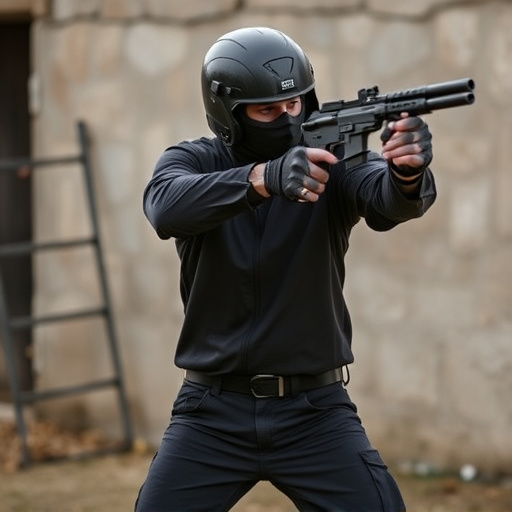
Both Tasers and stun guns are non-lethal weapons designed to incapacitate individuals through electrical impulse, but they operate on distinct principles. While both devices deliver a powerful shock, the key difference lies in their mechanism of action. A stun gun uses high voltage to disrupt muscle control, causing the target to experience intense pain and temporary paralysis. In contrast, Tasers employ a pair of probes that fire into the target, delivering an electrical current which interferes with nerve signals, resulting in muscular stiffness and disorientation.
In terms of voltage, stun guns typically operate at lower settings, often around 120,000 volts, while Tasers can reach higher levels, sometimes exceeding 500,000 volts. This difference in voltage contributes to varying levels of muscle interference, with Tasers generally causing more pronounced physical responses due to their advanced probe technology. However, both weapons are effective in incapacitating assailants for a brief period, providing crucial time for law enforcement or self-defense situations.
Tasers and stun guns both aim to incapacitate through electric shock, but they differ significantly in design and effectiveness. Tasers fire two probes connected to wires, delivering a high-voltage pulse that disrupts muscle control, while stun guns emit a continuous electrical discharge of lower voltage directly onto the target’s skin. Although both can cause temporary paralysis, stun guns may offer better penetration and less risk of probe detachment, making them preferable for certain situations. When choosing between the two, consider factors like intended use, power source, and the level of muscle interference required to ensure safety and effectiveness.